Peter White was 18 when he stepped off a barge onto the Lake Superior shore in the spring of 1849 with Robert J. Graveraet’s small party from the Marquette Iron Company. When he died in 1908, he had been the town’s postmaster, its first register of deeds, a state senator, its leading banker and, for more than 50 years, a member of its school board. The library on Front Street still carries his name.
Most of what follows comes from the history the Peter White Public Library keeps on its own website, which draws on the library’s archive of White’s life. It is a useful reminder of how much of present-day Marquette, from Presque Isle Park to the library itself, traces back to one man’s habit of joining every committee in town.
From a Mackinac store counter to Lake Superior
White was born Oct. 31, 1830, in Rome, New York. His family moved to Green Bay, Wisconsin, and he left home at 14 to work schooners on the Great Lakes, according to the library. He ended up clerking in a store on Mackinac Island for $24 a month.
That is where Graveraet found him. The party went by steamer to Sault Ste. Marie, picked up supplies and barges, and followed the south shore of Lake Superior for eight days to the spot that became Marquette. The library’s account says the group spent its first night with Chippewa Chief Charley Kawbawgam in his home. White, who had a gift for languages, began learning Chippewa, French and German.
He clerked at the iron company’s store from 1850. When the company folded a few years later, he opened his own store in 1854, and around the same time became the Carp River postmaster, carrying mail to the mining settlements that were springing up inland. The library credits him as the first postmaster in the Upper Peninsula to use dogsleds for winter mail. He held the Carp River and Marquette postal job for 12 years.
A long list of firsts
White won his first election in 1851 as Marquette County’s first register of deeds. He wrote the first bill of lading for the first shipment of iron ore to leave the peninsula, seven barrels sent to B.L. Webb of Detroit. He was the first customs officer at Marquette in 1857 and registrar at the U.S. Land Office. He formed the first bank in Marquette and incorporated the First National Bank, which the library dates to 1863.
He also sat on the committee that named two of the county’s mining towns. The library notes that Negaunee means “pioneer” in the Chippewa language and Ishpeming means “heaven.” Readers who have followed our coverage of the Vista Theater’s long effort to reopen in Negaunee are looking at a town whose name White helped choose.
In 1875, White was elected to the state Senate. In that seat, the library says, he wrote the legislation that gave Presque Isle to the City of Marquette. He then paid for a road through the island’s swampy ground himself and donated enough money to run the park for its first five years. He served as the city’s park and cemetery commissioner for more than 40 years.
The library that bears his name
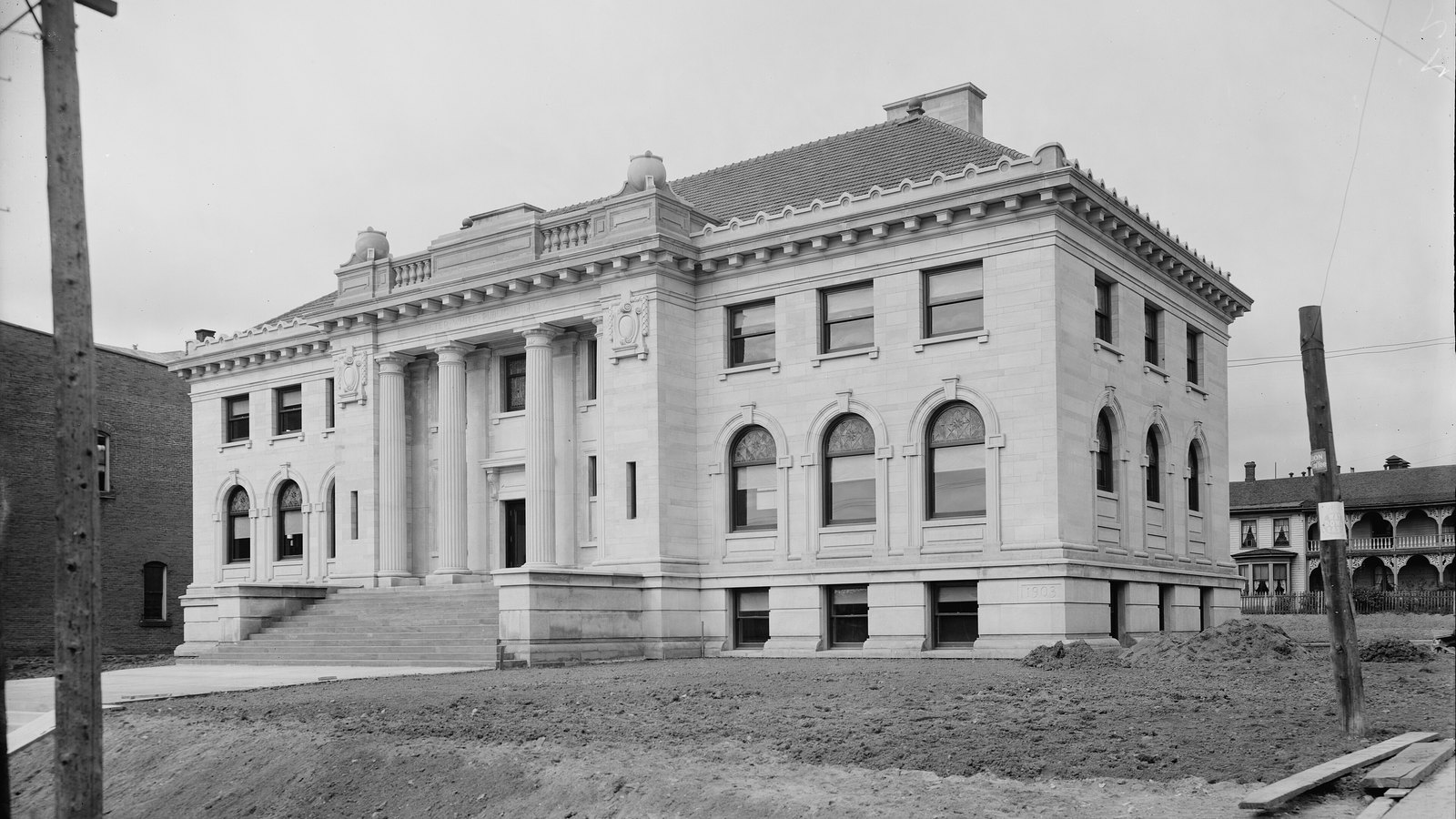
On March 27, 1891, a state legislative act combined White’s private library with the school district’s library to create the Peter White Public Library. By 1895 it had outgrown its space, and White led the push for a new building. John Munro and Mary Beecher Longyear donated the land at Front and Ridge streets in 1900. The building, designed by a Chicago firm with Indiana limestone, a red tile roof and custom stained glass, opened Sept. 22, 1904.
That 1904 building is still the core of the library, after a 1958 addition and an expansion to about 65,000 square feet that reopened in October 2000. The library now calls itself the largest public library in the Upper Peninsula, serving the city and Chocolay, Ewing, Sands, Skandia, Turin, Wells and West Branch townships. It has continued to put its local history collection in front of the public, including this fall’s expanded archive exhibition.
Grief, and a chapel on Front Street
White’s private life was marked by loss. He married Ellen Sophia Hewitt, daughter of Dr. Morgan L. Hewitt, in 1857, and the couple had six children. In 1878, the library says, their three youngest died of diphtheria, and their son Morgan died at 12. White paid for the Morgan Memorial Chapel at St. Paul’s Episcopal Church, where Tiffany Glass Co. windows honor his other children.
His daughter Mary, who married mining man Alfred O. Jopling, died in 1896. His daughter Frances married George Shiras III, the photographer and conservationist. Ellen White died in August 1905. Peter White died June 6, 1908, while on a business trip to Detroit.
A bust of White stands in the library’s circulation lobby, in the building at 217 N. Front St., where the collection he started is still growing. More stories about the people who shaped Marquette County are collected in our People & Profiles section.